
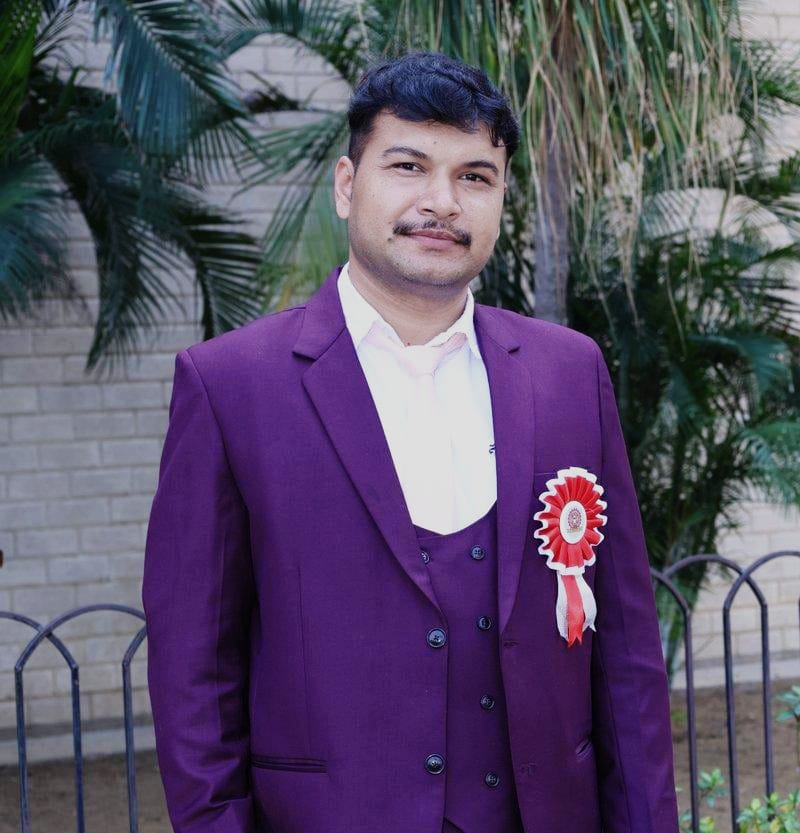
Interview with Dr. Ankur Sharma
Dr. Ankur Sharma, a dynamic academician and social reformer from Etawah, Uttar Pradesh, has emerged as a key figure in the field of sustainable agriculture and education. As the founder of Agri Meet Foundation and Royal Society of Agriculture, he has trained over 50,000 individuals across the globe. His pioneering work blends modern agricultural science with social impact. We sat down with Dr. Sharma ahead of HARVEST-2025, the 6th Global Agriculture Conference he is leading.
Interviewer — Can you tell us about your early life and where you’re from?
Dr. Ankur Sharma — I was born and brought up in Etawah, Uttar Pradesh. It’s a region with deep agricultural roots, which greatly shaped my interest in farming and rural development.
Interviewer — What inspired you to pursue a career in agriculture?
Dr. Ankur Sharma — Growing up in a farming family, I witnessed the challenges firsthand. I wanted to bring innovation and education to uplift rural communities.
Interviewer — How did your journey in education begin?
Dr. Ankur Sharma — It started with my formal education in agriculture. Over time, my passion expanded beyond learning to teaching, mentoring, and building institutions.
Interviewer — What is the Agri Meet Foundation?
Dr. Ankur Sharma — It’s a platform I founded to foster agricultural innovation, research, and skill development among students, farmers, and professionals.
Interviewer — And the Royal Society of Agriculture?
Dr. Ankur Sharma — It’s an academic society aimed at promoting scientific research, publishing, and policy dialogue in agriculture and allied sciences.
Interviewer — You’ve trained over 50,000 students — how did that happen?
Dr. Ankur Sharma — Through workshops, conferences, webinars, and training programs across India and abroad, using both online and offline models.
Interviewer — You’re known as an “edupreneur.” What does that mean to you?
Dr. Ankur Sharma — It’s someone who blends education with entrepreneurship — building sustainable systems to deliver impactful learning and employment outcomes.
Interviewer — What fields do you specialize in?
Dr. Ankur Sharma — Horticulture, agro-processing, post-harvest technology, organic farming, climate-resilient agriculture, and rural entrepreneurship.
Interviewer — You’ve received many awards. Which ones are most meaningful to you?
Dr. Ankur Sharma — Each recognition is special, but being awarded the Bharat Shiksha Ratna and Best Researcher Award stands out personally.
Interviewer — How many books have you written or edited?
Dr. Ankur Sharma — More than 32 books across various agricultural disciplines, most of them used by students and researchers nationwide.

Interviewer — And you hold patents as well?
Dr. Ankur Sharma — Yes, over 10 patents in agri-biotechnology and post-harvest innovation, developed with research collaborators and students.
Interviewer — Tell us about HARVEST-2025.
Dr. Ankur Sharma — HARVEST-2025 is the 6th Global Agriculture Conference. This year’s theme focuses on sustainability, innovation, and global collaboration.
Interviewer — What’s unique about this year’s event?
Dr. Ankur Sharma — It’s being held in hybrid mode with participation from top institutions in Iran, Russia, and over 30 Indian universities.
Interviewer — What are your goals for the conference?
Dr. Ankur Sharma — To create actionable collaboration, build a global dialogue on sustainable agriculture, and empower young minds.
Interviewer — How do you define innovation in agriculture?
Dr. Ankur Sharma — Innovation is about context — the right solution for the right problem, whether it’s a low-cost tech or a smart farming method.
Interviewer — What’s the biggest challenge Indian farmers face today?
Dr. Ankur Sharma — Access to timely knowledge, climate uncertainty, and weak post-harvest infrastructure remain key challenges.
Interviewer — How can youth be encouraged to join agriculture?
Dr. Ankur Sharma — By showing them agriculture is smart, profitable, and tech-enabled. They need role models and successful case studies.
Interviewer — You’ve also worked on women empowerment in agri. How?
Dr. Ankur Sharma — Through training modules, women-led startups, and awards like the Women in Agriculture Excellence Award to recognize their leadership.
Interviewer — What role does research play in your work?
Dr. Ankur Sharma — Research is at the heart of what I do. Every innovation must be data-backed and field-tested to be scalable.
Interviewer — Any international collaborations you’re proud of?
Dr. Ankur Sharma — Absolutely. Collaborations with University of Tehran, Southern Federal University, and AREEO Iran have been transformative.
Interviewer — What is your educational background?
Dr. Ankur Sharma — I hold multiple advanced degrees in agriculture and am a triple gold medalist — something I’m very proud of academically.
Interviewer — Who has influenced your leadership style the most?
Dr. Ankur Sharma — My rural upbringing and exposure to both grassroots farming and international academia shaped my inclusive leadership approach.
Interviewer — What is your leadership mantra?
Dr. Ankur Sharma — Lead with empathy, act with clarity, and build with purpose.
Interviewer — What are your future goals?
Dr. Ankur Sharma — To make agricultural education more accessible, develop 100 rural agri-hubs, and promote India as a global hub for agri-innovation.
Interviewer — How do you balance so many roles?
Dr. Ankur Sharma — With discipline, a passionate team, and strong time management. Delegation and vision alignment are key.
Interviewer — What are your hobbies beyond work?
Dr. Ankur Sharma — Reading, mentoring youth, and spending time in nature — it keeps me grounded.
Interviewer — One message for today’s students?
Dr. Ankur Sharma — Believe in your ideas, be curious, and don’t fear failure. Every step matters.
Interviewer — And for young agripreneurs?
Dr. Ankur Sharma — Agriculture is the future. Think bold, start small, and scale with purpose.

Interviewer: Dr. Sharma, you’ve worn many hats — researcher, educator, innovator, and social leader. How do you define your purpose in such a diverse journey?
Dr. Ankur Sharma — My core purpose has always been empowerment — whether it’s farmers, students, or rural women. I’ve realized that real transformation begins when knowledge meets action. Agriculture is not just a profession in India; it’s a way of life. By integrating science, technology, and education, I aim to elevate the dignity of that life. Whether I’m writing a book, training students, or launching a new agri-initiative, the goal is the same: to build a self-reliant rural India and make agriculture a global force for good.
Interviewer: With the rise of digital technologies and AI in agriculture, how do you see the future of farming evolving, especially for small-scale farmers?
Dr. Ankur Sharma — Technology is a double-edged sword. It can revolutionize agriculture but also widen gaps if not implemented inclusively. For small-scale farmers, we need frugal innovation — solutions that are affordable, scalable, and easy to adopt. AI, remote sensing, precision farming — these sound complex, but their applications can be simplified. For instance, we’ve launched mobile-based advisory services in vernacular languages, enabling farmers to make data-backed decisions. The future of farming lies in localization of technology — high-tech solutions made low-tech for ground-level impact.
Interviewer: You’ve trained over 50,000 people. That’s an incredible number. What’s your approach to training and capacity building that makes it so effective?
Dr. Ankur Sharma — Training, to me, is not about delivering lectures — it’s about creating transformation. We focus on experiential learning, role-based modules, and real-life case studies. Most importantly, we respect the learner’s background. A farmer, a student, and a startup founder learn differently, and our programs are designed with this diversity in mind. We use hybrid models — in-person sessions for hands-on work, and digital tools for flexibility and reach. And we always measure outcomes: how many started businesses, adopted new methods, or improved yield. Impact must be measurable.
Interviewer: Your foundation works actively in women empowerment. In your experience, what role do women play in agricultural transformation today?
Dr. Ankur Sharma — Women are the invisible backbone of Indian agriculture. They do everything — sowing, weeding, harvesting — yet they’re often left out of policy and credit systems. Our goal is to bring them to the front. We conduct women-centric agri-training, offer micro-loans through partners, and celebrate women achievers with awards and case studies. When you empower a woman farmer, you don’t just transform one person — you uplift a family, a village, even a generation. We’ve seen women go from seasonal workers to agri-entrepreneurs. That’s real change.
Interviewer: Let’s talk about HARVEST-2025. How do conferences like these contribute to policy, research, and real-world progress?
Dr. Ankur Sharma — Conferences are not just academic exercises — they are platforms for action. HARVEST-2025 brings together scientists, students, policymakers, NGOs, and agribusinesses on one stage. It sparks collaboration, introduces new research, and creates mentorship networks. This year, with 40+ universities and global partners, we aim to shape actionable agendas — climate-resilient farming, smart agritech adoption, and value-chain development. The discussions don’t end with the event — we follow up with pilot projects, research grants, and policy briefs. It’s a living ecosystem.
Interviewer: You’re also an award-winning author. What drives your writing, and who are you writing for?
Dr. Ankur Sharma — Writing is my way of reaching beyond borders. Not every student or farmer can attend my sessions, but they can read. I write to simplify complex topics — from post-harvest technologies to organic farming techniques — and make them accessible. My books are meant for learners, practitioners, and even policymakers who need practical knowledge. I also edit journals and books to give young researchers a platform. In a country like ours, democratizing knowledge is crucial. Books are tools of equality.
Interviewer: How do you measure the impact of your work across such varied domains — from rural training to academic publishing?
Dr. Ankur Sharma — Great question. For me, impact is not about numbers, but transformation. Yes, we’ve trained thousands and published dozens of books and papers. But I ask deeper questions: Did someone start a farm-based business? Did a rural girl enroll in an agri-college? Did a paper lead to a patent or a policy change? We use outcome mapping, feedback loops, and field visits to track progress. We also mentor follow-on leaders — so the work doesn’t stop with me. Sustainability is the true measure of success.

Interviewer: Dr. Sharma, can you tell us what inspired the idea of Agri Meet University and why you’ve chosen 2037 as the target year?
Dr. Ankur Sharma: The inspiration for Agri Meet University is deeply rooted in my experiences across rural India. I’ve witnessed firsthand the challenges farmers face — lack of access to quality education, outdated techniques, and minimal industry exposure. I envisioned an institution that bridges these gaps — a place where modern science meets grassroots reality. The year 2037 is not arbitrary; it’s a deadline that gives us the time to build thoughtfully, sustainably, and inclusively. This will be more than a university — it will be a movement to reimagine Indian agriculture.
Interviewer: What unique role will Agri Meet University play in transforming Indian agriculture?
Dr. Ankur Sharma: Agri Meet University will function as an incubator of ideas, a launchpad for innovation, and a hub of rural empowerment. It will blend research, education, entrepreneurship, and real-world extension services. Our curriculum will be practical and adaptive — from drone farming and climate-smart agriculture to agribusiness and intellectual property. The goal is not just to create graduates, but agripreneurs, policymakers, and changemakers. It will be the first institution of its kind to combine scientific rigor with community outreach on a national scale.
Interviewer: You’ve mentioned “Viksit Krishi, Viksit Bharat 2047” as a cornerstone of your mission. Could you elaborate on this vision?
Dr. Ankur Sharma: — ��Viksit Krishi, Viksit Bharat” is more than a slogan — it’s a national call to action. If we want a developed India by 2047, our agriculture must lead the way. Our vision focuses on three key areas: digital transformation, sustainable practices, and human capital development. Through Agri Meet, we aim to create policy-aligned innovations that uplift smallholder farmers, integrate climate resilience, and create rural economic hubs. We want to empower every farmer to be both a producer and a problem-solver. A prosperous farmer equals a prosperous nation.
Interviewer: How will Agri Meet University integrate technology and sustainability in its teaching and research?
Dr. Ankur Sharma: Technology and sustainability are not optional — they’re fundamental pillars. Our university will have centers for digital agriculture, precision farming, and climate adaptation. We will use AI to predict crop patterns, IoT to monitor soil health, and remote sensing for farm-level interventions. At the same time, sustainability will be embedded in every module — from water use efficiency to organic inputs and circular farming systems. Students won’t just learn theory; they’ll implement real projects with measurable social and environmental impact.

Interviewer: You’ve mentored thousands in research and intellectual property. Will this expertise be integrated into Agri Meet University?
Dr. Ankur Sharma: Absolutely. Research is power only when it’s protected and published. One major issue in Indian academia is the underutilization of intellectual property rights. At Agri Meet, we’ll create India’s first dedicated Agri-IPR Cell, helping students and researchers secure patents, publish globally, and commercialize innovations. I’ve personally mentored over 3,000 scholars and guided 2,000+ scientists in IP filings — this culture of knowledge ownership will be institutionalized at Agri Meet.
Interviewer: What will make Agri Meet University different from existing agricultural universities in India?
Dr. Ankur Sharma: The difference lies in our model: integrated, inclusive, and industry-driven. While most institutions focus solely on academics or extension, we’re bringing everything together. Agri Meet will function like an ecosystem — with startups, incubation centers, policy labs, digital platforms, and global exchange programs. We will also emphasize vernacular education and grassroots outreach. Our student will spend as much time in villages as in labs. And unlike others, we’re not building just for India — we’re preparing our graduates to lead globally.
Interviewer: You often speak about the emotional side of your journey — your father, Lord Hanuman, and your inspirations. How do they shape your vision?
Dr. Ankur Sharma: Every dream I’ve dared to dream has roots in faith and family. My father was my first teacher — humble, honest, and unshakably supportive. His ethics drive everything I do. Lord Hanuman, with his strength and devotion, reminds me that impossible is just a word. Whenever I’ve faced setbacks, I’ve drawn strength from these two forces. Agri Meet is not just a professional milestone — it’s a tribute to their guidance, a symbol of what values can build when paired with vision.
Interviewer: You’ve often praised Elon Musk as a role model. How has his journey influenced your work and mindset?
Dr. Ankur Sharma: Elon Musk represents the audacity to dream big and deliver bigger. His work ethic, perseverance, and visionary mindset inspire me daily. He challenges the status quo — not for ego, but for evolution. Like him, I believe in deep work, resilience, and taking bold risks. Agri Meet may not be building rockets, but it’s launching a revolution in its own way. If SpaceX can reach Mars, Agri Meet can surely reach every village in India with knowledge, innovation, and opportunity.
Interviewer: What legacy do you hope to leave behind, not just as a professional, but as a person?
Dr. Ankur Sharma — I want to be remembered as someone who brought dignity and innovation to agriculture — someone who broke silos between research, practice, and people. But more than legacy, I believe in continuity. If I can inspire 100 more changemakers to continue this journey, that’s enough. I want to build institutions, not just accolades. And as a person, I hope to be remembered for empathy — for listening, for including, and for always believing that even the smallest effort can sow seeds of lasting change.
Interviewer — Where can people connect with you or your programs?
Dr. Ankur Sharma — Through www.agrimeet.in or on WhatsApp at +91 6265589507. We’re always open to collaborations.


