
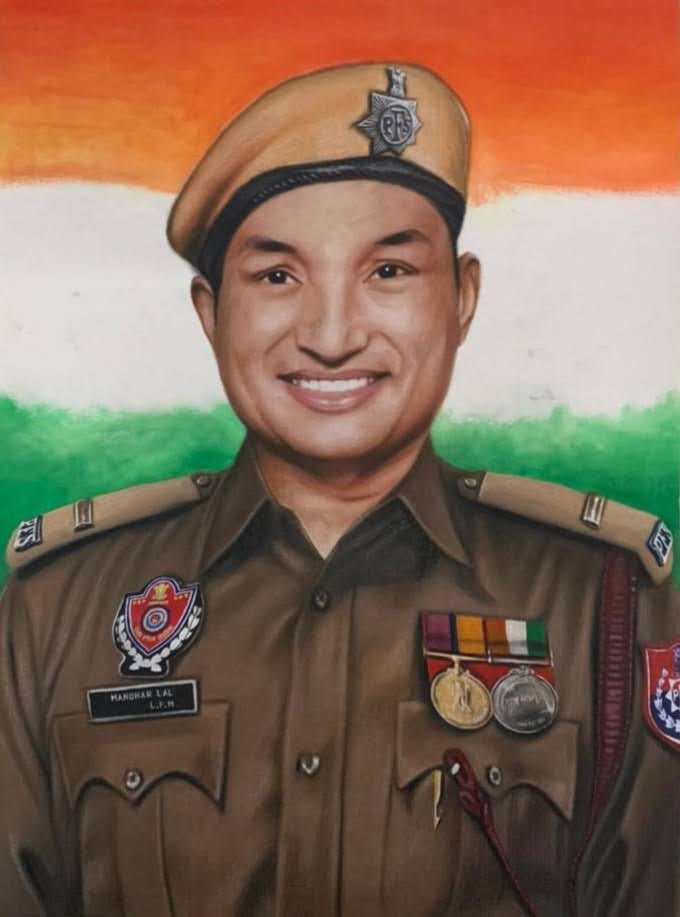
Manohar Lal, fondly remembered by many as Manohar Hans, Manohar Lal Hans, M.L. Hans, PFMG Manohar Lal, Martyr Manohar Lal, PFS Manohar Lal and LFM Manohar Lal PFMG, was a man whose life embodied dedication, discipline, and deep compassion for others. His journey from a small-town upbringing in Punjab to becoming a Leading Fireman with the Punjab Fire Service (Ludhiana Fire Brigade) is not just the story of one man’s career—it is the story of courage that ultimately cost him his life in the line of duty. Born on 24th May 1967 in Jalandhar, and hailing from Nawanshahr in the culturally rich Doaba region, Manohar Lal lived a life defined by service, humility, and a relentless commitment to the safety and well-being of others.
Early Life & Education
He received his primary education from the government high school in his village. His childhood name was Vinod. However, at the time of his school admission, the teacher, noticing that he was from a poor household, remarked that his name sounded like that of a film star, questioning whether such a name was appropriate. Out of a sense of mockery or disdain, the teacher changed his name to Manohar (later on Manohar Lal).
Manohar had a deep interest in studies, but his family’s financial condition was very weak. His father, Shri Rangi Ram, worked as a peon in the principal’s office at a government school, and his mother, Smt. Jeeto, was a sanitation worker in the local village municipality. But in his final years, before attaining veergati (attained martyrdom in the line of duty), Manohar spent meaningful time caring for his mother, who had been paralyzed for nearly a decade. He remained devoted to her service, fulfilling his duties as a son with sincerity and compassion.

Struggle Since Childhood
Manohar was born into a joint family and spent his childhood in conditions of economic hardship. He remained deeply grounded throughout his life—truly a man connected to his roots. To support the household, he began working as a laborer at a young age. By the age of 12 or 13, he had started working in the local grain and vegetable markets, lifting and transporting heavy sacks and loads. Manohar also helped his mother with everyday chores—shaping cow dung cakes for fuel and cleaning drains when needed. These tasks, though tough and often looked down upon, were a routine part of his early life and shaped his grounded, hardworking nature.
His father stood approximately 5’7″. However, due to the physically demanding labor Manohar undertook from such a young age—often carrying heavy loads on his head—his own height did not develop fully. He remained of medium stature, standing around 5’5″, a fact that deeply affected him throughout his life. He often lamented that his short height was a result of the burden he had to bear in his formative years.
Interestingly, his cousin—the son of his paternal uncle, who worked as an assistant to a veterinary doctor in a government animal dispensary—did not have to endure such hardships in childhood, and perhaps as a result, grew taller than Manohar, exceeding even their father’s height of 5’7″.
According to his son, Navan Hans, Manohar had always encouraged him from a young age to work on increasing his height. He would often say:
“Just keep stretching your body—hang on the bar! You need to grow taller.”
Manohar left no remedy or technique unexplored—from Tadasana yoga to market-bought products claiming height increase—he tried everything for his son. By the time Navan reached 10th or 11th grade, his height had noticeably improved, and Manohar felt immense joy seeing the results. He would proudly tell his colleagues how his son had outgrown him in height—something that made him genuinely happy. Today, Navan Hans stands approximately 5 feet 9½ inches tall.
Passion for Music Suppressed
At a young age, Manohar developed a deep interest in music. But in a modest village with no music classes or trained teachers, there were few avenues to nurture such a passion. Still, he found solace in an unexpected place—the local Khusre/Mahant community. Their home became his informal music school, where he began spending time and gradually joined their singing sessions, often adding melodic flourishes to their dholak-accompanied songs. The Mahants were known for their powerful and resonant voices, and Manohar found inspiration among them.
However, this musical journey was short-lived. One evening, when his father, Rangi Ram, discovered that his son had been singing regularly at the Mahants’ gathering place, he was furious. That night, when Manohar—known as “Bittu” at home—tried to slip in quietly, he found the door locked from inside. Before he could react, his father’s angry voice rang out:
“This door will only open if you promise to give up this singing nonsense. If I ever find you in their company again, consider this home closed to you forever. If you’re ready to leave that path behind, give me your word and step in. Otherwise, you’re no longer welcome here.”
Under the pressure of his family’s narrow-minded views, Manohar was compelled to suppress his deep passion for music. That night, he gave his father a solemn promise and stepped away from his musical pursuits—a promise never to return to that path again. But how could the fire of musical love be extinguished so easily? The small spark continued to smolder within him, and during his college years, it eventually ignited a new interest—the art of songwriting.
During his college days, Manohar often saved money by walking instead of taking the bus, yet bound by the promise he had made to his father, he could never fully pursue or formally learn music. However, even today, he holds a treasured diary containing nearly 28 self-written, unreleased songs. These compositions span a wide range of themes—from love, romance, and spirituality to cultural and social issues. His writing also touches upon powerful subjects like dowry, female empowerment (such as the Beti Bachao movement), and the emotional ties of Babul (a father’s bond with his daughter). These songs were never meant for the world. They were written for his soul.
Throughout his life, Manohar remained an ardent fan of Hans Raj Hans. He wasn’t just admired in his own neighborhood—he was also the only university graduate in his entire village, a rare and proud achievement.
Arranged Marriage and Early Marital Challenges
In keeping with family traditions, Manohar’s marriage was arranged by his elders. The alliance was fixed with Usha, the middle daughter of Shri Bakshi Ram—an employee in the railway department—and his wife Shanti Devi, residents of Kariha, a nearby village in the Nawanshahr district (now Shaheed Bhagat Singh Nagar) of Punjab.
Though Usha had a dusky complexion, it was her kind and gentle nature that truly won Manohar’s heart. At the age of 27, he tied the knot with her in a traditional Hindu ceremony, surrounded by loved ones and rituals.
However, within just six months of marriage, internal family disputes—primarily fueled by conflicts among the sisters within the household—began to create serious tensions. By the seventh month, the newlywed couple found themselves compelled to separate from the joint family.
For a brief period, they settled in a rented house in Phillaur town, close to Usha’s elder sister. It was during this challenging yet intimate time that their first daughter, Tamanna Hans, was born—a moment of joy amid the turbulence.
A Job Switch, Born of Necessity
Manohar had been working under LA Ashok Bajaj in the Law Branch of the Ludhiana Municipal Corporation for nearly 6 to 7 years. Before marriage, he commuted from Rahon (in Nawanshahr), and after marriage, the commute continued from Phillaur. Daily travel had become a growing challenge—physically tiring and emotionally draining. What they needed now was a stable home in Ludhiana itself.
One day, a circular was issued in the department. It invited employees of the corporation to apply for positions in the Fire Department, should they be interested.
While there were multiple paths available for promotion within the Department, Manohar’s situation was unique—it wasn’t just about career growth, it was about living conditions. Upon learning that employees in the Fire Brigade were provided with government housing (quarters), Manohar felt a spark of interest.
For him, the decision wasn’t just professional—it was deeply personal.
From his childhood, Manohar’s pride and self-respect had always prevented him from asking for help, whether from friends or relatives. Even after his marriage, he never once turned to his parents or family for support. For Manohar, the comfort of having his own roof over his head was non-negotiable. He was willing to sacrifice the joys of a 9-to-5 job, weekends off, and spending festivals with his family.
Instead, he made a bold decision—to step into the world of danger, playing with fire itself. He applied to join the Fire Control Force, a department that demanded 12-hour shifts and a grueling 10-day cycle of day/night rotations. It was a choice that reflected not just his need for a steady residence, but also his desire to fulfill the needs of Child and Family, no matter the cost.
Manohar, a graduate from Panjab University, was intelligent, focused, and mature by nature. He steadily cleared each stage of the Fire Department selection process—which included fire drills and various physical and health-based mock tests. These tasks involved climbing ropes 8 to 10 feet high, lifting ladders, demonstrating fire-control techniques, and running while carrying heavy sacks weighing around 60-65 kg. His short height often proved advantageous in such tasks, and his strong, athletic build—honed from playing kabaddi—made him a natural fit.
Selection Officer’s Kindness: Lifelong Gratitude
He fell short of the minimum height requirement. At that moment, the dream of securing a residential government quarter seemed to slip away. But fate took a turn when a kind-hearted senior fire officer on the selection board—who was not only impressed but fully convinced of Manohar’s capability—personally adjusted his recorded height by half an inch. He knew, deep down, that Manohar was exactly the kind of physically active and mentally alert person the department needed.
At that time, no one—not even the officer himself—could have imagined that this selected recruit would one day be honored with a national award by the Home Minister of India.
After his selection and joining, Manohar was allotted an official residence at the Fire Station in Focal Point Phase V, Ludhiana. It was there that his son, Navan Hans, was born. That one act of kindness by the officer became a lifelong blessing in Manohar’s journey.
How Son’s Name ‘Navan Hans’ Was Chosen
For Manohar, this marked the beginning of a completely new chapter in life. Like the police, he too now wore a khaki uniform—a symbol of duty and discipline. The birth of his son during this fresh start felt like more than just a coincidence; it was a sign of renewal. That’s why he named his son Navan Hans– “Navan” meaning new, a reflection of this new beginning.
A Life of Simplicity, Discipline, and Inner Depth
Manohar, a man whose blood carried both hard work and determination, always preferred a simple life. He was never the kind to show off or seek attention. While embracing family life with grace, he deeply valued the company of spiritual masters and often found peace in listening to their discourses.
He was especially influenced by Giani Sant Singh Ji Maskeen, whose teachings left a lasting impression on him. Manohar had personally arranged to collect almost all of Maskeen Ji’s discourses on CDs, which he would listen to regularly. Spiritually inclined, he remained deeply connected to Gurbani and read numerous spiritual texts over the years.
These influences shaped him into a man of soft, compassionate thoughts—yet his khaki uniform instilled in him a strict sense of discipline. On the outside, he appeared tough and principled, which often made him seem stern, even intimidating, to some colleagues and relatives. In truth, his personality was much like a coconut: hard on the outside, but soft within.
Throughout his life, his wardrobe remained minimal and consistent:
- Uniform during duty,
- White kurta-pyjama at home,
- Coat-pant suit for formal events and ceremonies.
A Devoted Husband and Father & Son
Manohar never wanted his family—especially his children—to go through the hardships he had endured in his own life. Determined to give them a better future, he raised his children with firm discipline. As a result, there was never a single complaint about their behavior—at school, at home, or in society. His daughter, Tamanna, consistently excelled in academics. His son, Navan Hans, though a bit mischievous during his school days, was not only highly intelligent but also actively participated in extracurricular activities. Alongside his studies, he was a key member of his school’s music team and regularly represented the school in Punjab School Education Board’s co-academic competitions, often winning silver or bronze medals year after year.
Navan’s passion for music even surpassed that of his father. It seemed only natural—as though the musical flame Manohar had once been forced to suppress had found new life in his son. In his senior school years, Navan went on to become the captain of the school’s music team.
Grounded in Humility, Guided by Compassion
No matter how far Manohar rose in life, he never forgot his humble beginnings. Though he was known for his temper, in moments of compassion, he felt no less than a divine messenger. He helped many people throughout his life—quietly, without expectation. He had a special affection for children, especially young girls, in whom he saw the divine presence of Mata Rani.
His family deity was Maa Chintapurni and Jwala Ji, and he viewed every little girl as a reflection of the goddess herself. Helping underprivileged children—whether by providing them with stationery, clothes, or school support—was something he did often and without hesitation.
For several years, he extended regular support to a neighbor—a young widow and her 7-8-month-old daughter—after the sudden passing of her husband. Manohar saw the woman as a daughter and helped according to his means by covering expenses for milk, clothes, food, diapers, and medicines. It was as if this silent service was written in his destiny by God himself.
In fact, just days before his passing, on 12th November 2017, Manohar took part in the wedding and kanyadaan of a young girl from an unknown family—a final act of kindness that, perhaps, completed the circle of his earthly duties.
One Day, When Dr. Grewal Said, “You Should Quit Smoking”
It was the year 2010—around Diwali—when one evening, while Manohar was buying vegetables in the market, he suddenly felt a sharp pain in his chest. At the time, the city had been experiencing frequent and intense fire incidents. The pain he felt closely resembled a heart attack.
As the pain worsened, he rushed to Grewal Hospital on Gill Road, Ludhiana. After undergoing tests, Dr. Grewal reviewed the reports and said,
“Manohar Lal ji, your condition is quite serious. Your heart valves are blocked—and look at this—the amount of black smoke inside your system! Just tell me, how many cigarettes do you smoke in a day? You must stop immediately, or things could take a serious turn.”
Manohar was surprised and replied,
“Doctor saab, what are you saying? Me—smoking? I’ve never even touched cigarettes, alcohol, or non-veg food—let alone consumed them!”
Dr. Grewal asked,
“Then are the reports lying? Everything is clearly visible here. If not cigarettes—where is this smoke coming from?”
At that moment, Manohar smiled and shared details about his profession—how, due to staff shortages, he had been on continuous 24-hour duty, often exposed to life-threatening fires during that time. He explained the nature of his work, the scale of the incidents, and the physical exposure to smoke and flames. Dr. Grewal was not only shocked but visibly concerned. From a medical standpoint, he strongly recommended heart surgery. But Manohar, ever courageous and strong-willed, refused the surgery. Instead, he chose to recover at home using traditional and naturopathic remedies—and, remarkably, he did.
A Master of Firefighting, A Servant of Duty
Manohar made remarkable progress in his field, becoming highly skilled and a true master of his work. His approach to fire management and emergency planning was exceptional—so much so that handling even the most dangerous fires felt like second nature to him.
In fact, the tragic fire of 2017, in which he lost his life, wasn’t the biggest he had faced. Over his 18 years of service, Manohar had confronted fires nearly four times more severe — ��and prevailed. In 2015, he was promoted to the post of Leading Fireman. His natural leadership, calm presence during operations, and the ability to work in perfect sync with his team made him an ideal officer.
His juniors admired him deeply—many touched his feet out of respect and prayed to become like Shri Manohar Lal Ji one day. He was lovingly called “Ustaad Ji” by many in the department.
It is often said that respect from juniors comes only when you’ve shown the same to your seniors. But Manohar didn’t just respect his seniors—he once risked his own life to save one.
In 2006, during a rescue operation at a burning cotton mill in Kanganwal, his senior Fire Officer Ravinder Kumar got trapped inside. Manohar rushed in to save him, sustaining serious injuries to his leg and shoulder in the process. Even in that condition, he lifted him and brought him out to safety—saving his life.
Manohar himself never kept count of how many fires he had put out, or how many injuries he had sustained. Over the years, parts of his skin had been burned, and his front teeth were artificial—something he joked about with children, saying they were “buffalo teeth.”
On 23rd June 2017, journalist Grewal from Dainik Savera visited fire stations unannounced for inspection—checking the readiness of fire tenders and emergency preparedness. At Gill Road Fire Station, Leading Fireman Manohar Lal and his team were on duty.
Off-camera, she asked him,
“This work—firefighting—is extremely dangerous. Don’t you ever feel afraid while putting out such terrifying fires?”
Manohar smiled gently and replied with his typical philosophy:
“Fear comes in three stages—before the work begins, while doing the work, and after it’s done. For me, it usually comes after I’ve put the fire out.”
And with that, he laughed. (Video is available on Youtube with name — ‘Fire System in Ludhiana is an utter failure’ by Dainik Savera)
Manohar often said,
“Since our family deity is Maa Jwala, how could I ever dare to take fire lightly?”
Yet, he had a personal ritual: Whenever responding to a fire call, he would silently say,
“Hey Maa, I’m your son, here to fulfill my duty. These people are suffering losses. Please protect your son. Calm down, Maa—please calm down.”
Then, with full energy and heart, he would enter the flames.
The ironic beauty was—it was only later, lying in bed at night, that he would replay the intensity of the fire he had just faced. He would thank the goddess for keeping him safe and fall asleep whispering:
“Jai Mata Di.”

Beyond the Flames—A Life of Service
After being promoted to Leading Fireman (LFM), M.L. Hans took on the role of a true leader—confidently leading his team in complex fire and rescue operations across the city.
But firefighting wasn’t limited to just extinguishing flames. His department handled a wide range of emergencies:
- Rescuing people stuck in lifts,
- Saving those who had fallen or drowned in canals or rivers,
- Animal rescues,
- Conducting fire safety audits and fitness checks for city buildings and malls,
- Organizing seminars and awareness camps in schools and colleges to educate students about basic fire safety and prevention.
He was so fearless that he would drag burning LPG cylinders out of danger zones with his own hands, risking his life to protect others and prevent greater disasters.
In one such incident, LFM Manohar personally rescued an unconscious sewerman who had collapsed inside a manhole, completely covered in sewage.
The next day, a local newspaper published a striking image: Manohar holding the man in his arms, lifting him from the filth. His son, Navan Hans, innocently asked,
“Daddy, didn’t you feel disgusted doing that?”
Manohar, slightly taken aback, responded lovingly,
“Kakey! he’s our brother too. What’s there to feel disgusted about? He was doing his duty—and so was I.”
Manohar had seen many high-risk situations in this line of work. There were countless “close calls”—moments where danger was just inches away—but every single time, he chose to step forward.
In the year 2016-17, Leading Fireman Manohar Lal’s Career Reached its Peak
Almost every day, his name appeared in newspapers and media reports. The highlight came in May 2017, when The Times of India published a half-page article solely on him. The headline read:
“With Blazing Routine, 50-Year-Old Fireman Is Always on His Marks.”
In the same month, a massive fire broke out at Mallika Textiles. Manohar Lal, along with other firemen, rescued six colleagues who were trapped inside the factory after the main shutter collapsed. Thick smoke could have been fatal, but the four firefighters managed to pry the shutter open with their bare hands and pull their teammates out.
In the process, Manohar Lal’s hands were severely burned.
However, not everyone in the department appreciated his rising fame…
2017 Suffian Chowk Tragedy: A Hero’s Last Call
In 2017, Suffian Chowk, Ludhiana, witnessed one of the worst fire and building collapse disasters in Punjab’s recorded history—a tragedy that would later become a defining moment in Manohar Lal’s service:
On the morning of November 20, 2017, it was a day no one could have foreseen—a day that would change everything. Manohar, who had defied death countless times before, began the morning like any other. He shared tea and breakfast with his wife, packed his lunch tiffin, and left home right on time. At exactly 8:00 AM, he reported for duty at Gill Road Fire Station, Ludhiana.
Moments after arriving, he was informed that a fire call had already come in—a major fire had broken out at Amarson Polymers, a plastic manufacturing unit near Suffian Chowk in the Industrial Area of Ludhiana. Without delay, he and his team took the fire tender and left for the site.
Upon receiving the emergency call, Fireman Kirti, a member of his team, later said,
“None of us knew that the tiffin Sir had brought from home would never be opened… Days later, we had to throw away the food he never got to eat.”
A massive fire broke out. Due to the nature of the materials involved, it rapidly intensified, engulfing the multi-storey building in thick smoke and flames. Despite the fire being largely under control by midday, the structural integrity of the building had been severely compromised.
Local residents said the building had been constructed illegally. Although official permission was granted for only five floors, two additional floors had been built at the rear without approval. The structure was completely unfit for industrial use. Yet, nothing was done. Locals believed that Gola, the factory owner, had strong political connections—perhaps that’s why no authority ever dared to question him.
At approximately 12:15 p.m., without warning, the illegally constructed five-storey building collapsed, burying several people under the debris. Among those trapped were Manohar Lal and other fire department personnel who had remained inside the building to ensure the fire was fully extinguished and that no one remained inside.
In the immediate aftermath of the collapse, extensive rescue operations were launched by multiple agencies, including the National Disaster Response Force (NDRF), State Disaster Response Force (SDRF), Punjab Police, and the Indian Army. Heavy machinery was deployed to clear the debris, and search teams worked tirelessly in the hope of finding survivors.
Manohar’s entire family, along with close relatives, waited at the site for nearly a week, hoping for any news of him. In the beginning, there was hope that he might come out alive. But as days passed—by the third or fourth day—that hope slowly turned into the painful anticipation of at least recovering his body.
No one could have known what fate had written, Manohar Lal’s body was never recovered.
Among the nine fire personnel involved in the operation, six bodies were eventually found. But three firefighters—including Manohar Lal—were never located. Leading Fireman Manohar Lal, along with two of his junior fellow firefighters—Sukhdev Singh and Manpreet Singh—remained unaccounted for.
Despite continued efforts and the use of advanced equipment, their bodies could not be recovered due to the severity of the collapse and the dangerous conditions within the wreckage.
By mid-December 2017, based on eyewitness accounts, the extent of the damage, and the duration of time since the collapse, a committee chaired by the Deputy Commissioner of Ludhiana, and comprising senior administrative and medical officials, reached the conclusion that survival was no longer possible. On December 29, 2017, Manohar Lal was officially declared deceased, and the Municipal Corporation was instructed to issue his death certificate. Manohar Lal was survived by his family, including his young son, Navan Hans, who at the time of the tragedy was a minor.
Honors & Awards
Throughout his life, Leading Fireman Manohar Lal received numerous awards, medals, and honours for his service and contributions, both within and beyond the fire department.
A man of many talents, he had a deep passion for music and writing. During his youth, he actively participated in and often hosted various cultural and official events.
At the Central Fire Station, Ludhiana, he was known for personally organizing and hosting farewell functions for retiring colleagues—an act that reflected his sense of camaraderie and respect for the fire service community.

Jalandhar Doordarshan Award:
Among his notable early recognitions was the Doordarshan Award he received in 1992 from Jalandhar Doordarshan, acknowledging his literary and creative contributions during a time when his interest in writing was at its peak.
Posthumous:
- On 25 January 2019, the Government of Punjab officially recommended the names of 13 firemen from the Punjab Fire Service, including Leading Fireman Manohar Lal, for the President’s Fire Service Medal for Gallantry (PFMG), to be awarded on the occasion of Republic Day. This marked a historic moment, as Local Government Minister Navjot Singh Sidhu announced that for the first time in decades, fire service personnel from Punjab were being considered for a national gallantry award by the President of India, under the Ministry of Home Affairs. Sidhu also declared Leading Fireman Manohar Lal a martyr on behalf of the Government of Punjab, along with eight other firemen who had sacrificed their lives in the line of duty.

- On 2 January 2020, Martyr Manohar Lal was posthumously awarded the President’s Fire Service Medal for Gallantry by Hon’ble Home Minister Amit Shah during an official ceremony held at the National Fire Service College (NFSC), Nagpur. Representing the family, Navan Hans, along with his mother and sister, attended the ceremony. The medal was received by Manohar Lal’s wife from the Home Minister, in the presence of other dignitaries. This medal, one of the highest honors in Indian fire services, was awarded in recognition of his exceptional courage and sacrifice. At the time, the President of India was Shri Ram Nath Kovind.
Legacy Beyond the Flames
Leading Fireman Manohar Lal never lived for applause. They did not seek fame, nor were they ever concerned with recognition. Their life was like a quiet flame—burning only to bring light, never to draw attention.
From a young boy lifting sacks in village markets to becoming a national award-winning fire officer, their journey was never paved with comfort—but with sacrifice, resolve, and unwavering duty. They gave up their dreams of music to honor a father’s word, bore the weight of poverty without complaint, and walked through raging fires so that others could return home safely. They never counted their medals. Their proudest moments were far more personal—watching their children grow taller and stronger, hearing their son sing the songs they were once forced to silence, feeding a hungry child without the world ever knowing. They chose a life of relentless service—one that offered no weekends, no luxuries, no celebrations. Their khaki uniform became both a badge of duty and a second skin. Their home was not a house of comfort, but a government fire quarter where emergency sirens often replaced moments of rest.
In 2017, when duty called for the last time, they did not hesitate. They never had.
The building collapse at Suffian Chowk buried more than debris.
It buried one of Punjab’s most courageous sons.
Their body was never recovered. There was no final farewell, no last rites.
But does a hero ever truly disappear?
No.
Manohar Lal did not leave.
They live on—in every firefighter who dares to step forward, in every child they once helped silently, and in every narrow alley and street where their siren once rang. They live in the ink of news reports, in media headlines that once bore their name, and in the heartbeats of their team who still whisper, “Ustaad Ji was here.” They live in a diary of 28 unreleased songs, handwritten and tucked away—waiting for the day their son, Navan Hans, might bring them to life. Songs about love, society, faith, and the feminine spirit—composed in silence, meant for the soul.
They live in the unspoken prayers whispered before every mission:
“Mother Goddess, I’m your son. I’m going to help your people. Please calm the flames—and protect me.”
And they live on in the national fire service records, where their bravery was etched in bold print—not for what they said, but for what they did.
Because not every legacy is carved in marble.
Some are burned into memory—by fire, by sacrifice, and by the unyielding dignity of duty.
They may not have returned from that fire.
But they never left.
Their story is not lost.
It is immortal—carried by sirens, by silence, by soot.


