
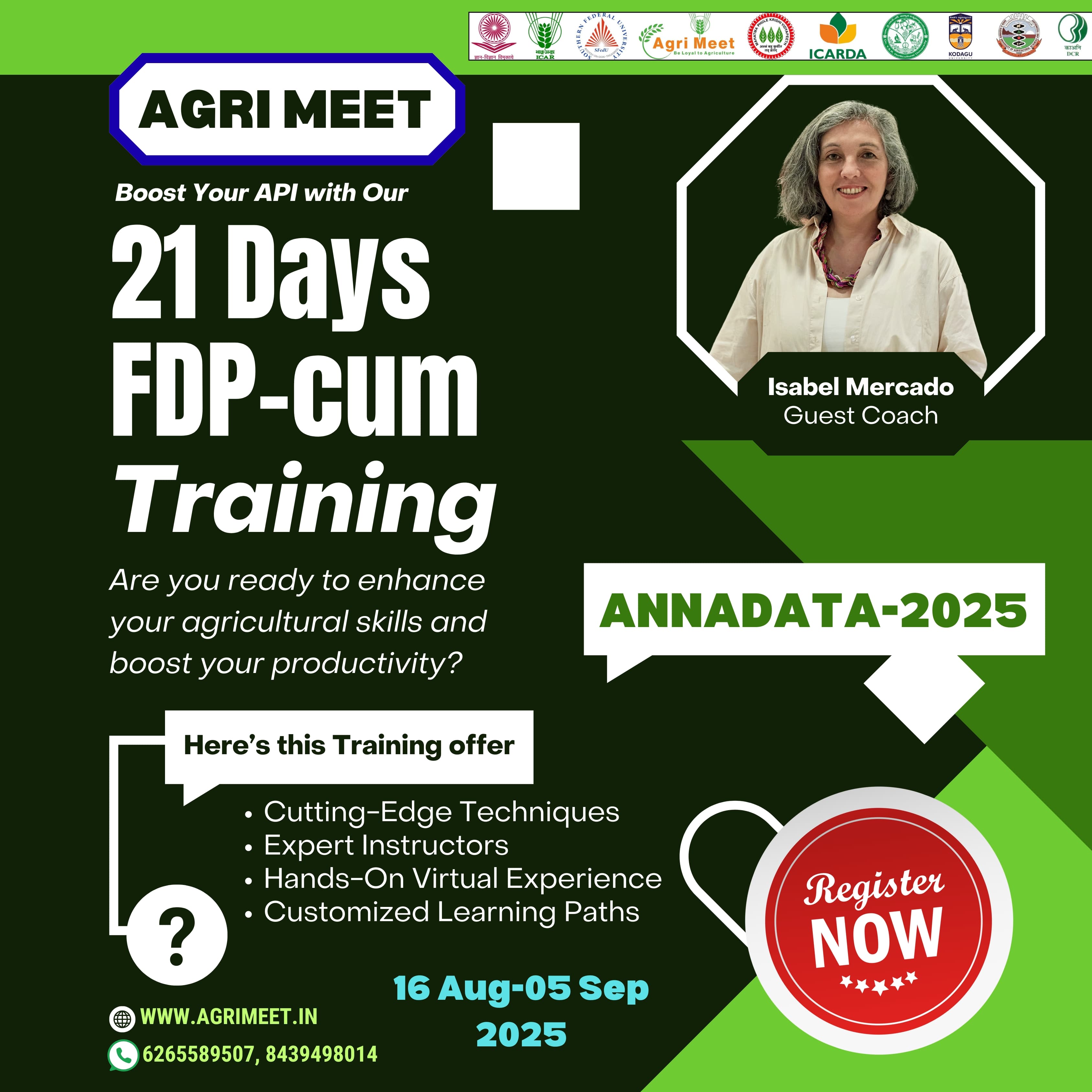
New Delhi, India – In a bold step toward revolutionizing India’s agricultural education landscape, Dr. Ankur Sharma, a distinguished academic visionary and policy strategist, has inaugurated ANNADATA–2025, a 21-day International Faculty Development and Training Program aimed at transforming how agricultural knowledge is taught, shared, and applied. The event, which kicked off on August 16, 2025, is already garnering national and international attention for its scale, ambition, and impact.
Brought to life through the efforts of the Agri Meet Foundation, Bharat, in collaboration with academic giants such as UGC-MMTTC Jodhpur, Southern Federal University (Russia), Dr. YSRHU Andhra Pradesh, and multiple ICAR and Central Agricultural Universities, ANNADATA–2025 is more than a professional development program. It is a movement—a strategic initiative designed to retool India’s agricultural faculty for the demands of a rapidly changing world.
At its core lies the belief that the future of farming begins in the classroom, and the key to progress is empowering those who teach.
Dr. Ankur Sharma: Building a National Platform for Academic Empowerment
The intellectual force behind ANNADATA–2025 is none other than Dr. Ankur Sharma, whose career has long been dedicated to academic excellence and agricultural transformation. Serving as Course Director, Dr. Sharma has curated a program that doesn’t merely aim to inform but to inspire. His philosophy is rooted in the idea that if India is to become a global leader in sustainable and smart agriculture, its educators must first be equipped with the latest tools, methods, and perspectives.
Dr. Sharma’s ability to convene institutions across state and international lines reflects not only his influence in the academic world but his unwavering commitment to knowledge democratization. From professors and scientists to early-career researchers and university students, the program is welcoming over 1,000 participants who will gain exposure to some of the most pressing and promising themes in modern agriculture.
Global Learning, Local Impact
What sets ANNADATA–2025 apart is its balanced approach to global relevance and local applicability. Sessions cover a wide array of transformative topics—climate-resilient agriculture, AI and IoT in farming, post-harvest technologies, integrated farming systems, data-driven decision-making, and regenerative agricultural practices. These subjects are taught not in isolation but through the lens of India’s unique rural and ecological context.
The presence of international scholars and institutions—from Russia, Iran, and Lebanon—adds richness to the learning environment. Their contributions help participants explore comparative global models, creating space for cross-cultural exchange and academic partnership.
From Training to Transformation
The ANNADATA–2025 initiative is designed with long-term impact in mind. It bridges the gap between academic knowledge and grassroots practice, offering a rare blend of classroom theory, real-world case studies, and field-based demonstrations. As participants engage with experts and experiment with new pedagogical tools, the larger goal remains clear: to cultivate a new generation of educators who can lead India’s transition toward sustainable agriculture.
As an added incentive, participants are given the opportunity to publish their research work in the internationally recognized journal Nature Science, a gesture that further underlines the program’s commitment to academic growth.
Collaborative Excellence: Partners Powering ANNADATA–2025
ANNADATA–2025 stands as a testament to the strength of global and national collaboration, driven by the unified vision of empowering agricultural educators. The program is organized by Agri Meet Foundation, Bharat, in esteemed knowledge partnership with UGC-MMTTC Jodhpur, Southern Federal University (Russia), Dr. YSRHU A.P, DCR Puttur Karnataka, ATARI Jabalpur, Kodagu University Karnataka, SKUAST Kashmir, MPKV Rahuri, IIRR Hyderabad, and a robust consortium of ICAR institutes and Central Agricultural Universities. This collective brings together unparalleled academic expertise, field experience, and research strength, creating a dynamic platform for innovation, policy integration, and skill development. Through this powerful synergy, ANNADATA–2025 is not only elevating faculty training but also laying the foundation for a resilient and future-ready agricultural education ecosystem in India.
Shaping the Educators of Tomorrow
Dr. Sharma, in his opening remarks, emphasized the importance of educator empowerment in driving agricultural transformation. “We often talk about doubling farmer incomes, building climate resilience, and leveraging digital technologies. But none of that is possible if the people educating future farmers and scientists are not prepared for the future themselves,” he stated. “ANNADATA–2025 is our response to that challenge—it is about training the trainers, empowering the educators, and giving new life to agricultural academia.”
With a meticulously designed curriculum, a collaborative international network, and a visionary leader at the helm, ANNADATA–2025 is shaping up to be one of the most impactful academic training programs in Indian agricultural history. As the program progresses over the coming weeks, it promises not just to build skills but to spark a cultural shift in how agricultural knowledge is shared, adapted, and applied across India.


